Guitar Chords for Every Song
Find chords by name and type, then use clear diagrams to play the songs you love. Learn what finger numbers, open and muted strings, and barre markings mean.
Explore Chords by Type
Major Chords
Minor Chords
Seventh Chords
Suspended & Other Chords
Browse Guitar Chords A–Z
A Major
A bright, familiar open chord used in countless song progressions.
A Minor (Am)
A simple minor shape with a softer, more reflective sound.
A Seventh (A7)
An easy open seventh chord that adds a bluesy pull.
A Minor Seventh (Am7)
A mellow variation that fits smoothly into many songs.
A Suspended Second (Asus2)
An airy A chord that swaps the third for an open B string.
A Suspended Fourth (Asus4)
A ringing variation that creates tension before resolving to A.
A Major Seventh (Amaj7)
A warm, dreamy A chord with a gently jazzy colour.
B Minor (Bm)
A common barre chord worth learning for songs in G, D and A.
How to Read a Chord Diagram
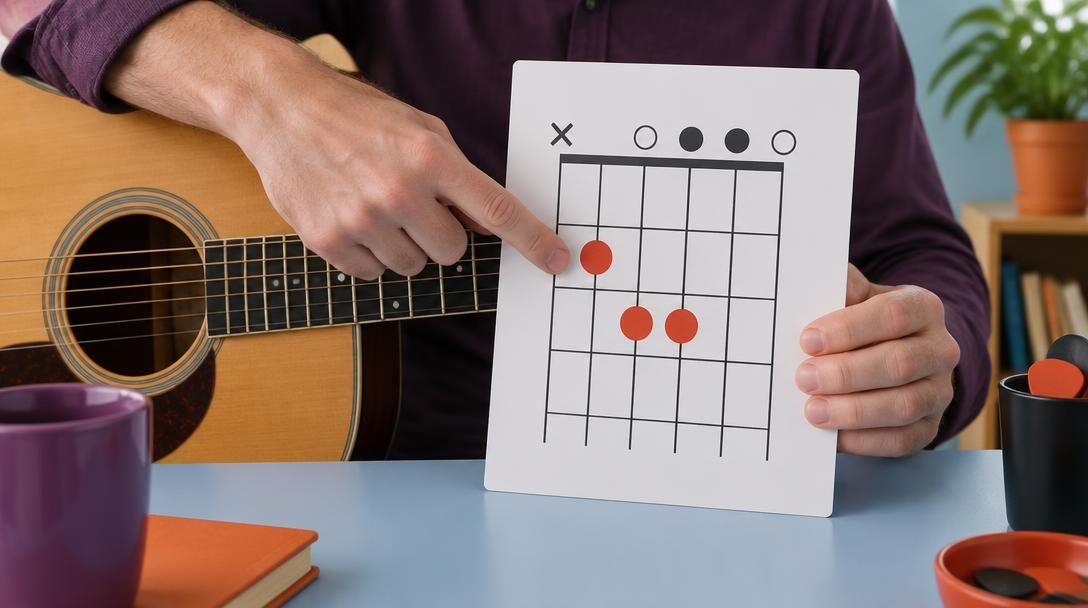

Think of a chord diagram as a front view of your guitar neck: the vertical lines are strings, from low E on the left to high E on the right, and the horizontal lines mark frets. A dot shows where to press a string; a number inside or beside it tells you which finger to use: 1 for index, 2 for middle, 3 for ring, and 4 for pinky. A number beside the diagram tells you where the first pictured fret sits on the neck. Above the strings, O means play the string open, while X means leave it out when you strum. Once you can read those marks, you can turn any diagram in the library into a chord you can play.
Put the Diagram into Your Hands

Open Chord Shapes
Place your fingertips just behind the marked frets and let any strings marked O ring freely. Keep your fingers curved so neighbouring strings stay clear.

Fretted Chord Positions
Check the starting-fret number before you play. For a movable shape, put each finger on its marked string and fret, then strum only the strings the diagram includes.

Barre Chord Technique
A long bar across the diagram means your index finger holds down several strings at one fret. Set the barre first, add the remaining fingers, and pick each string to check for a clear note.
From Shapes to Songs
Find the Chords Behind Each Progression
When a song introduces an unfamiliar chord, look it up here by name and type before you start playing. Compare its diagram with the chords around it in the progression: notice which fingers can stay in place, which need to move, and whether the next shape uses open or muted strings. Practising those changes in order makes it easier to follow the intro, verse, chorus, and bridge rows in the song library. Keep the reference nearby as you learn, then return to the progression and play through each transition at a comfortable tempo.
Guitar Chord FAQs
Get quick answers to common chord questions, then use the diagrams to find a shape that works for your song.
What do the letters and symbols in chord names mean?
The letter names the root note. An “m” means minor, “7” adds a seventh, and “sus” indicates a suspended chord. For example, Am and A7 are different chords, so check the full name shown in the song.
How do I read a guitar chord diagram?
The vertical lines represent strings, with the low E string on the left. Horizontal lines represent frets. Place your fingers where the dots appear, then strum only the strings indicated.
What do the numbers beside the dots mean?
They show which fretting finger to use: 1 is your index finger, 2 your middle, 3 your ring, and 4 your little finger. Your thumb normally rests behind the neck.
What do O and X mean above the strings?
O means play that string open, without pressing a fret. X means mute or avoid that string. Following these marks helps the chord sound clear.
What is a barre chord?
A barre chord uses one finger, usually your index, to press down multiple strings at the same fret. Start with light, even pressure and check each string as you practise.
Which chord variation should I use for a song?
Choose a shape that matches the chord name and lets you change comfortably to the next chord. If a song calls for G major, for example, you can try different G shapes and use the one that sounds clear and fits the progression.