Learn Guitar, Then Play the Songs You Love
Build the practical skills to read chord progressions, keep time, and play your first song—then explore the song library with confidence.

Nine Lessons From First Chord to First Song
Get Ready to Play
Learn the parts of your guitar, tune each string, and read the chord diagrams you’ll find throughout the song library.
Build Your Playing Skills
Try your first three chords, practise changing between them, count 1-2-3-4, and follow a chord progression.
Put It All Into a Song
Add a steady strum, play your first complete song, and use what you’ve learned to explore more songs at your own pace.
Start With a Guitar That’s Ready to Play
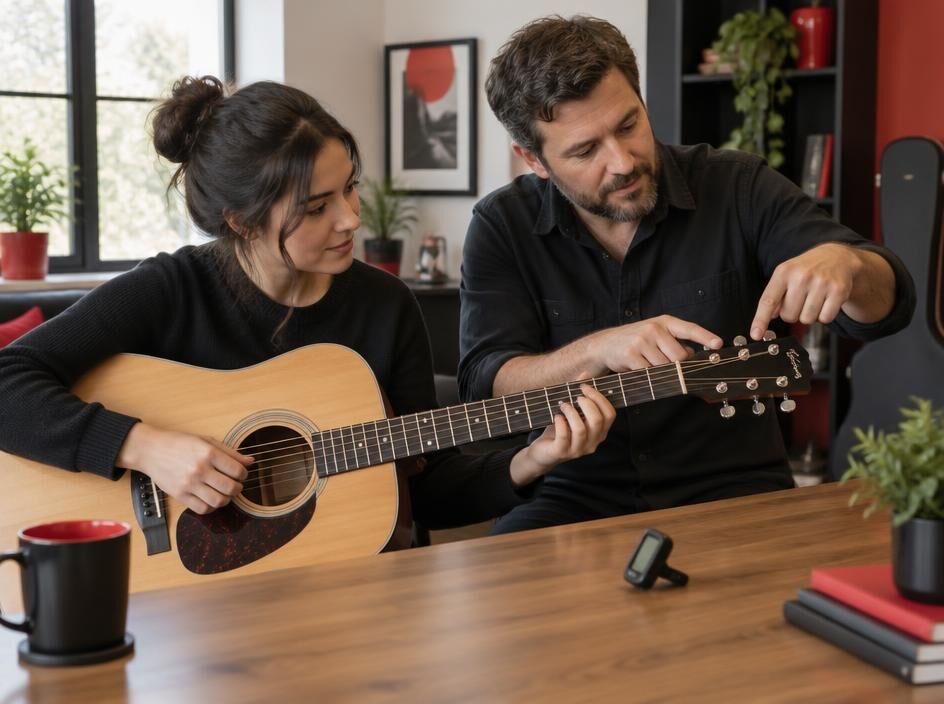
Before learning a song, get familiar with the strings, frets, neck, and tuning pegs. The strings are named E, A, D, G, B, and E from thickest to thinnest; the frets help you find the notes and chords shown in our diagrams. Use a tuner to bring each open string to the right pitch, adjusting its tuning peg a little at a time. Check your tuning each time you practise so the chords you learn sound clear when you play them in a song.
Read Chord Diagrams, Play Real Songs
Find the Right Strings
Follow the diagram from the low E string to the high E string to see exactly where each chord shape belongs.
Spot Open and Muted Notes
An O means play the string open; an X means leave it out. These small marks help every chord ring clearly.
Place Your Fingers with Confidence
Match the numbered dots to your fingers, then use the same shapes when they appear in a song-library progression.
Build Your First Chord Vocabulary
E Minor
Start with a two-finger shape and strum all six strings to hear a full, resonant chord.
A Minor
Set three fingers on neighbouring strings and strum from the A string down.
C Major
Learn where your fingers land, then check that each string you play sounds clear.
G Major
Stretch into this familiar open shape, a staple of beginner-friendly songs.
D Major
Form a compact triangle on the top three strings and strum from the D string.
Read the Chord Order
Follow chord names from left to right to see which shape comes next in a progression.
Count the Bars
Use each bar line to track how long to stay on a chord before moving on.
Try a Song Pattern
Play G, C, D and G in order, then look for that sequence in the song library.
Practise the Changes Your Songs Actually Use
Step 1
Pick two neighbouring chords from a song progression, such as G to C, and form each shape slowly.
Step 2
Switch back and forth without strumming. Notice which fingers can stay close to the strings as you move.
Step 3
Count four steady beats on each chord, add a simple down-strum, then try the change in the song.
Lesson 06 · Find the Beat
Count Four, Then Change Chords
Tap your foot and count aloud: 1, 2, 3, 4. Keep each number evenly spaced, then repeat without stopping. In a song progression, each chord often fills one four-count bar: play G on 1, keep counting through 4, and switch to C for the next 1. Try | G | C | G | D | slowly, saying the chord name as you change. If your fingers arrive late, keep the count going and join in on the next beat. Follow the bars in a song from the library to see how a steady pulse helps you stay with the music.
Watch: Strum Along With the Beat
In this video lesson, follow a simple downstroke on each count of 1, 2, 3, 4, then add an easy down-up motion while your counting stays steady. Watch how the strumming hand keeps moving through chord changes, giving the song a dependable rhythm even when a new chord takes an extra moment. Practice the pattern over a progression from the song library so you can play along with more confidence.
Project: Play Your First Library Song
Beginner Song Challenge

Client
A guided first-song practice for new guitarists using Simple Guitar Method’s song library.
Date
Practice time: 15–20 minutes
My Role
Tuning · Chords · Rhythm · Song
Choose a beginner-friendly song from the library and tune your guitar before you start. Read its chord diagrams, place your fingers for each chord, and rehearse the changes in the opening progression without strumming. Next, count 1, 2, 3, 4 through each bar and add steady downstrokes. Follow the song’s coloured section rows to move from verse to chorus, keeping your strumming hand going even if you miss a change. Play through the whole song at a comfortable pace, then repeat the section that needs work. Your goal is a complete first play-through with a steady beat—not perfect fingers on every chord.
Ready to Play Your First Song?
Start the beginner course, practise each new chord with a real song, and keep building confidence in the song library—one progression at a time.